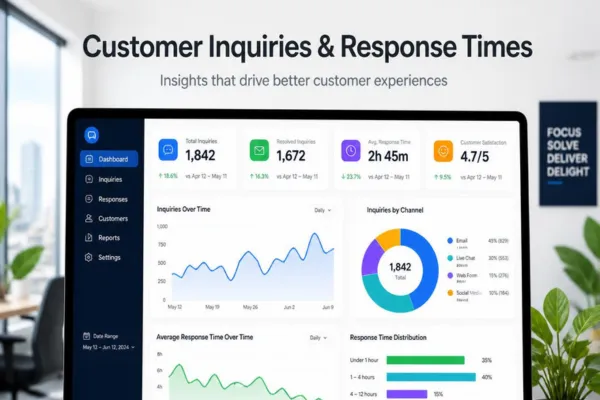
Why Fast Lead Response Can Increase Sales
Introduction
A potential customer visits your website.
They're interested in your service.
They complete your contact form and ask for more information.
Then they wait.
An hour passes.
Several hours later, they still haven't received a response.
By the next day, they've already contacted another business.
Sound familiar?
For many businesses, this happens more often than they realize.
While companies invest heavily in marketing to attract new leads, they sometimes overlook what happens after someone reaches out. Yet that first response can shape a prospect's entire perception of your business.
People today expect quick communication. Whether they're sending a website inquiry, a Facebook message, or requesting a consultation, they want to know someone is listening.
Responding quickly isn't just good customer service—it can directly influence whether that lead becomes a paying customer.
In this article, we'll explore why lead response time matters, the hidden costs of delayed communication, and how businesses can create systems that ensure every inquiry receives prompt, professional attention.
Why Lead Response Time Matters
Every new inquiry represents opportunity.
It's a person who has already shown interest in your business.
They're looking for answers, comparing options, and deciding who they can trust.
The longer a lead waits for a response, the more likely they are to continue searching elsewhere.
Fast communication demonstrates professionalism, reliability, and respect for the customer's time.
Even if you're not able to provide a complete answer immediately, acknowledging the inquiry reassures prospects that they've been heard.
The Hidden Costs of Slow Responses

A delayed response doesn't just affect one conversation—it can have a ripple effect across your business.
Common consequences include:
lost sales opportunities
lower customer confidence
reduced conversion rates
inconsistent customer experiences
missed follow-ups
overwhelmed staff trying to catch up
Over time, these issues can quietly limit business growth.
Why Businesses Respond Slowly
Most businesses don't intentionally ignore leads.
Instead, delays usually happen because:
inquiries arrive from multiple platforms
there isn't a central communication system
follow-ups rely on manual processes
staff members are busy serving existing clients
no one has clear ownership of incoming leads
As the business grows, these small inefficiencies become much more noticeable.
The First Five Minutes Matter
Imagine two businesses offering similar services.
Business A responds within minutes with a friendly confirmation and clear next steps.
Business B replies the following day.
Which one feels more trustworthy?
Prompt communication creates momentum.
It keeps conversations moving while the customer's interest is still high.
Five Ways to Improve Lead Response Time

1. Centralize Your Communication
When inquiries arrive through Facebook, email, website forms, and text messages, it's easy to lose track.
A centralized communication system brings every conversation into one place, helping your team respond more efficiently.
2. Automate the Initial Response
Customers don't necessarily expect an immediate solution.
They appreciate knowing their inquiry has been received.
An automated response can:
thank them for reaching out
confirm receipt of their message
provide an estimated response time
share helpful resources
This simple step builds confidence while giving your team time to respond personally.
3. Assign Lead Ownership
Every new inquiry should have a clear owner.
Whether it's a salesperson, customer service representative, or business owner, assigning responsibility reduces confusion and ensures nothing gets overlooked.
4. Use a Visual Sales Pipeline
Tracking inquiries through pipeline stages helps teams quickly identify:
new leads
active conversations
proposals sent
follow-up opportunities
closed sales
Visibility leads to better accountability.
5. Review Your Response Process Regularly
Business needs change over time.
Regularly evaluate:
average response time
busiest inquiry periods
communication bottlenecks
customer feedback
Continuous improvement keeps your system effective as your business grows.
Real-World Examples
Marketing Agency
A digital marketing agency received inquiries from Facebook, LinkedIn, and its website.
Without a central system, some messages were overlooked for days.
After implementing automated acknowledgments and a unified inbox, response times improved dramatically, creating a more consistent client experience.
Home Services Company
A local service business often missed inquiries while employees were on-site with customers.
By using automated responses and centralized lead tracking, every inquiry received immediate acknowledgment, even outside business hours.
Business Consultant
A consultant managing discovery calls manually found it difficult to reply quickly during client meetings.
Automation ensured prospects received instant confirmation and scheduling information while the consultant focused on current clients.
Best Practices
✔ Respond as quickly as possible
✔ Use automation to acknowledge inquiries
✔ Keep customer information organized
✔ Review your response process regularly
✔ Make communication easy across every channel
Common Mistakes
❌ Waiting until the end of the day to check inquiries
❌ Managing conversations across multiple apps
❌ Forgetting to assign lead ownership
❌ Relying entirely on memory for follow-ups
❌ Ignoring inquiries outside business hours
Expert Insight
Businesses often focus on generating more leads when the real opportunity lies in responding better to the leads they already have.
Improving response time doesn't necessarily require hiring more people—it often requires creating better systems.
When communication is organized, automated where appropriate, and supported by a CRM, businesses can respond faster without adding unnecessary workload.
Conclusion
Every inquiry is an opportunity to start building trust.
The speed and consistency of your response can influence whether a prospect continues the conversation or moves on to another business.
By centralizing communication, automating initial responses, and creating clear follow-up processes, businesses can improve customer experience while increasing operational efficiency.
HighLevel Stream helps businesses streamline lead management, automate responses, and organize customer communication in one connected platform—making it easier to respond quickly and confidently.
If your business is receiving inquiries but struggling to respond consistently, HighLevel Stream can help you build a lead response system that keeps every opportunity moving forward.
