
What Happens After a Customer Says “Yes”? How to Build a Better Client Onboarding Process
Introduction
A customer finally says yes.
The proposal has been accepted.
The payment has been made.
The contract is signed.
That's a moment worth celebrating.
But here's an important question:
What happens next?
For many businesses, this is where the process becomes surprisingly unclear.
Someone sends a quick "Welcome!" email. Another team member asks for information that the customer already provided. The client isn't sure what they need to do next. Meanwhile, your team is trying to coordinate everything behind the scenes.
The sale may be complete, but the customer experience is just beginning.
This stage is known as client onboarding, and it can have a major impact on how customers perceive your business.
A smooth onboarding process makes clients feel confident and cared for. A confusing one can create uncertainty before you've even started delivering the service.
The good news is that a strong onboarding experience doesn't have to require hours of manual work.
With clear processes, organized customer information, and thoughtful automation, businesses can create an onboarding journey that feels professional without feeling robotic.
Let's look at how.
What Is Client Onboarding?
Client onboarding is the process of welcoming a new customer and helping them transition from "new customer" to an active client.
Depending on the type of business, onboarding might include:
sending a welcome message
collecting client information
sharing important documents
scheduling an initial meeting
explaining the next steps
introducing team members
providing access to resources
setting expectations
The exact process will look different for every business.
A marketing agency won't onboard a client exactly like a business coach.
A home service company won't have the same process as a consultant.
But the objective is similar:
Make the transition into the customer relationship simple and clear.
Why Client Onboarding Matters

A customer has already trusted you enough to buy.
Now you're responsible for reinforcing that decision.
A good onboarding process can help:
Build Confidence
Customers know what to expect and what happens next.
Reduce Confusion
Clear instructions prevent unnecessary back-and-forth communication.
Improve Communication
Clients know where to find information and who to contact.
Save Your Team Time
Standardized processes reduce repetitive administrative work.
Create a Better First Impression
Your customer's first experience after purchasing can influence how they view your business long-term.
What Happens When Onboarding Is Disorganized?
Imagine hiring a marketing agency.
You sign the agreement and make your payment.
Then... nothing.
Two days later, someone sends an email asking for information you thought you had already provided.
Then another person sends a different message asking you to schedule a call.
You aren't sure which documents you need to submit or when the project actually begins.
The agency might be excellent at marketing.
But the onboarding experience makes the business feel disorganized.
This is why customer experience isn't just about the service itself.
It's also about the process surrounding the service.
The 6-Step Client Onboarding Framework
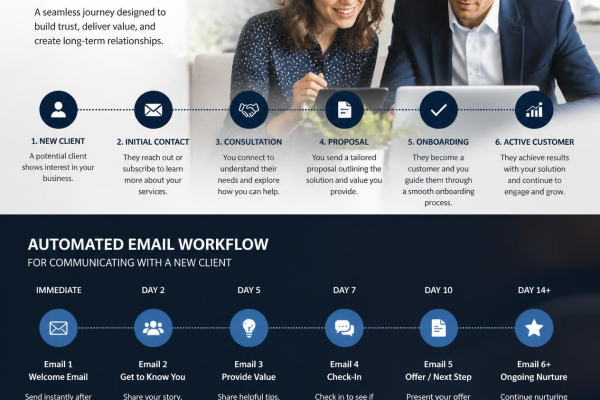
1. Start With a Clear Welcome
Once a customer becomes a client, acknowledge it.
A simple welcome message can confirm:
that their purchase was received
that they're officially onboard
what happens next
who they can contact
This immediately reduces uncertainty.
2. Tell Them What to Expect
Don't make customers guess.
Give them a simple roadmap.
For example:
Step 1: Complete the onboarding form
Step 2: Schedule your kickoff call
Step 3: Submit required materials
Step 4: Meet with the team
Step 5: Begin the project
Even a basic checklist can make the experience feel much more organized.
3. Collect Information in One Place
Businesses often lose time because client information is scattered across:
emails
spreadsheets
forms
messaging apps
documents
A centralized system makes it easier for your team to access the information they need without repeatedly asking the customer for the same details.
4. Automate Routine Communication
Not every onboarding message needs to be sent manually.
You can automate things like:
welcome emails
reminders
onboarding instructions
appointment confirmations
follow-up messages
internal team notifications
This creates consistency while allowing your team to focus on the parts of onboarding that require a personal touch.
5. Set Expectations Early
One of the easiest ways to improve client relationships is to establish expectations from the beginning.
Explain:
response times
communication channels
project timelines
responsibilities
important deadlines
Clear expectations prevent misunderstandings later.
6. Know When Automation Should Stop
This part is important.
Good automation doesn't eliminate human interaction.
There are moments when a customer needs an actual person.
A welcome email can be automated.
A complex strategy conversation shouldn't be.
A reminder can be automated.
A relationship shouldn't be.
The best onboarding systems use automation to handle predictable tasks while leaving meaningful interactions to people.
What Can Be Automated During Onboarding?
Here are some practical examples.
After Purchase
Customer receives an automated welcome message.
↓
Onboarding Form
Customer receives a link to provide required information.
↓
Appointment
Customer receives a scheduling link for the kickoff meeting.
↓
Reminder
The system sends an automated reminder before the meeting.
↓
Internal Notification
Your team is notified when onboarding information is completed.
↓
Follow-Up
Customer receives the next instructions automatically.
This creates a structured journey without requiring someone to manually coordinate every step.
Real-World Example: A Marketing Agency
Imagine a small marketing agency onboarding five new clients in one week.
Without a system, the team might need to manually:
send five welcome emails
request information from each client
schedule five kickoff calls
send reminders
notify team members
follow up with clients who haven't completed forms
That's a lot of repetitive administration.
With a structured onboarding workflow, many of those steps can happen automatically.
The team still provides strategy, communication, and personal attention.
But they aren't spending their time copying and pasting the same messages.
How to Improve Your Current Onboarding Process
You don't need to rebuild everything overnight.
Start by asking:
What happens immediately after someone becomes a customer?
Document it.
Then ask:
Where do customers usually get confused?
Fix those points.
Next:
Which steps are repetitive?
Look for automation opportunities.
Finally:
Where does the customer need human interaction?
Make those moments intentional.
This simple audit can reveal significant opportunities for improvement.
Common Client Onboarding Mistakes
❌ Sending too much information at once
❌ Making customers figure out the next step
❌ Asking for the same information repeatedly
❌ Relying entirely on manual communication
❌ Having different onboarding processes for different team members
❌ Automating every interaction and removing the human element
Best Practices for Better Onboarding
✔ Keep the process simple
✔ Give customers a clear roadmap
✔ Centralize important information
✔ Automate repetitive communication
✔ Set expectations early
✔ Give clients access to a real person when needed
✔ Review the onboarding experience regularly
The Real Goal of Onboarding
Client onboarding isn't simply an administrative checklist.
It's the bridge between making the sale and building the relationship.
The customer has already decided to trust your business.
Your onboarding process should reinforce that decision.
When customers know what to expect, where to go, and what happens next, they feel more confident.
And when your team has a clear process to follow, they can deliver that experience more consistently.
That's a win for everyone.
Expert Insight
Many businesses focus heavily on the moment a prospect becomes a customer.
But the moments immediately afterward can be just as important.
A smooth onboarding experience tells customers:
"You made the right decision."
It demonstrates organization before the actual work begins.
And when onboarding is supported by the right systems, your business doesn't have to choose between efficiency and personal service.
You can have both.
Conclusion
A customer saying "yes" isn't the end of the customer journey.
It's the beginning of a new stage.
A thoughtful client onboarding process helps customers understand what happens next, gives your team a clear workflow, and creates a stronger foundation for the relationship ahead.
The most effective onboarding systems combine clear processes, centralized information, timely communication, and thoughtful automation.
HighLevel Stream helps businesses bring these pieces together so new customers can move from purchase to onboarding with less friction and more confidence.
If your current onboarding process involves too much back-and-forth, repeated manual tasks, or customers asking, "What's next?" it may be time to rethink the system behind it.
HighLevel Stream can help you create a more organized onboarding workflow that keeps your team efficient while giving clients the experience they expect.
