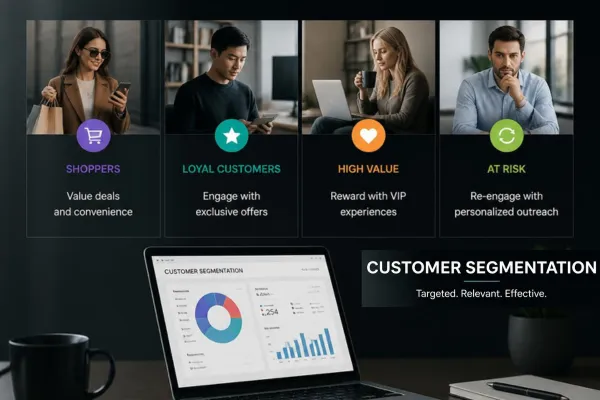
Customer Segmentation: How to Stop Sending the Same Message to Everyone
Your Customers Are Not All at the Same Stage
Imagine this.
You have 500 contacts in your database.
Some are brand-new leads.
Some asked for information but never booked.
Others are current clients.
A few are past customers who have not heard from you in months.
And some have already purchased several times.
Now imagine sending the same email, offer, reminder, or message to all 500 people.
It might be convenient.
But it probably isn't very effective.
The problem isn't necessarily your message.
The problem is that not everyone needs the same message at the same time.
That is where customer segmentation becomes valuable.
Customer segmentation allows businesses to organize contacts into meaningful groups based on their characteristics, behavior, needs, or stage in the customer journey.
Instead of communicating with everyone as one large audience, you can communicate with people based on where they actually are.
That creates a more relevant experience—and relevance matters.
What Is Customer Segmentation?
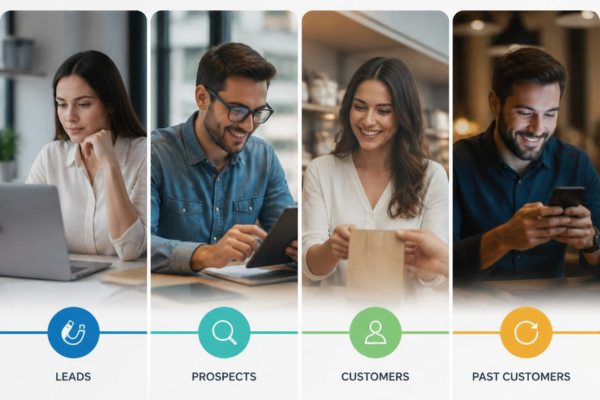
Customer segmentation is the process of dividing your customer or contact database into smaller groups that share similar characteristics or behaviors.
For example, a business might segment contacts into:
New leads
Qualified leads
Prospects who booked a call
Customers who recently purchased
Long-term customers
Past customers
People who have not responded recently
Contacts interested in a specific service
Customers in a specific location
Leads who downloaded a particular resource
The goal is not simply to create more lists.
The goal is to make your communication more intentional.
A business coach, for example, should not necessarily communicate with a brand-new subscriber in the same way they communicate with someone who has already completed a coaching program.
Likewise, a service business should not send a promotional message to a customer who is currently waiting for a scheduled appointment.
The more context you have, the more relevant your communication can become.
Why Sending the Same Message to Everyone Can Hurt Your Marketing
It is easy to think that sending one message to your entire database saves time.
Technically, it does.
However, saving time does not always mean creating better results.
Consider these examples.
Example 1: A New Lead
A new lead may still be learning about your business.
They probably need:
Education
Trust-building content
Answers to common questions
Information about your services
A simple next step
Sending them a message intended for existing customers may feel premature.
Example 2: An Existing Customer
An existing customer already knows your business.
They may need:
Helpful updates
Service reminders
Additional resources
Relevant offers
Support
Opportunities to purchase another service
They don't necessarily need the same introduction that a new lead receives.
Example 3: A Past Customer
A past customer may already understand your value.
However, they may simply need a reason to return.
That could mean a new service, seasonal offer, helpful reminder, or useful piece of content.
This is why segmentation matters.
Different people can require different conversations.
7 Practical Ways to Segment Your Contacts
You don't need hundreds of complicated categories to get started.
In fact, creating too many segments can make your system harder to manage.
Instead, start with categories that actually influence how you communicate.
1. Segment by Customer Journey Stage
One of the most useful ways to organize contacts is by where they are in the customer journey.
For example:
New Lead → Qualified Lead → Appointment Booked → Customer → Repeat Customer
Each stage represents a different relationship with your business.
A new lead may need education.
A booked appointment may need preparation and reminders.
A new customer may need onboarding.
A repeat customer may need additional offers or loyalty communication.
This structure makes it easier to determine what someone should receive next.
2. Segment by Interest
Not every customer is interested in every service you provide.
Suppose a marketing agency offers:
Website development
SEO
Social media management
Paid advertising
CRM setup
A contact who specifically asked about SEO should not automatically receive the same messaging as someone interested in website development.
By recording interests, you can make future communication more relevant.
Instead of asking:
"What can we send everyone?"
You can ask:
"What would be useful to this particular group?"
That is a much stronger marketing question.
3. Segment by Engagement
Another useful approach is looking at how contacts interact with your business.
For example:
Highly engaged contacts
Occasionally engaged contacts
Unresponsive contacts
Recently active contacts
Contacts who booked
Contacts who clicked or replied
Engagement data can help you determine what should happen next.
A highly engaged lead may be ready for a sales conversation.
Someone who has not interacted with your business for months may need a different re-engagement approach.
The important thing is not to treat both contacts as if they have identical levels of interest.
4. Segment by Purchase History
For businesses that sell multiple products or services, purchase history can provide valuable context.
You could identify:
First-time customers
Repeat customers
Customers who purchased a specific service
Customers who have not purchased recently
This allows businesses to create more relevant offers.
For example, a customer who purchased an introductory service six months ago might be a better candidate for an advanced service than someone who has never interacted with the business.
The information is already there.
The opportunity comes from organizing it properly.
5. Segment by Location
Location can also influence communication.
A cleaning company, for example, may serve multiple cities.
A consultant may have clients across different regions.
An agency may work with businesses in several markets.
Instead of sending every location-specific message to everyone, businesses can organize contacts geographically.
This becomes especially useful when:
Services differ by location
Offers are location-specific
Events happen in specific areas
Business hours vary
Local promotions are available
Simple segmentation can prevent irrelevant messages from reaching the wrong people.
6. Segment by Client Type
Your audience may also contain different types of customers.
For example, a business might serve:
Entrepreneurs
Coaches
Consultants
Agencies
Local businesses
Professional service providers
Each group may have different priorities.
An agency may care about scalability and client management.
A local service business may care more about bookings and lead response.
A coach may care about consultations, onboarding, and program enrollment.
When your database reflects these differences, your communication can become much more specific.
7. Segment by What Should Happen Next
This is one of the most practical ways to think about segmentation.
Instead of only asking:
"Who is this person?"
Ask:
"What should happen next?"
For example:
Contact Group | Possible Next Step |
New lead | Educational follow-up |
Interested prospect | Consultation invitation |
Booked appointment | Reminder and preparation |
New customer | Onboarding |
Existing customer | Continued support |
Past customer | Re-engagement |
Unresponsive lead | Reactivation |
Repeat customer | Relevant next offer |
This turns segmentation from a simple organizational exercise into an operational tool.
Customer Segmentation Should Support Personalization
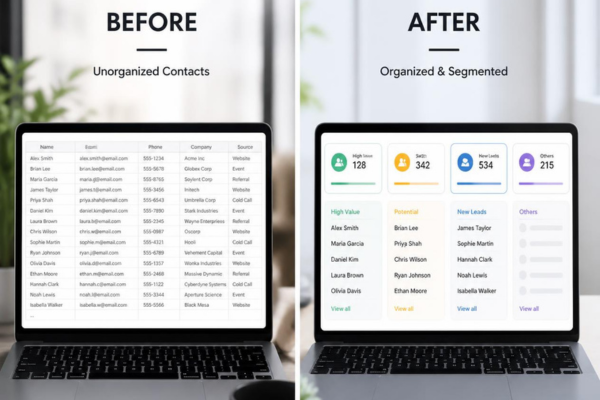
There is an important distinction here.
Segmentation is not the same as personalization.
Segmentation creates the groups.
Personalization determines how you communicate with those groups.
For example:
You might create a segment called "Past Customers."
That tells you who belongs in the group.
Your next decision is what message makes sense for them.
Perhaps you want to:
Introduce a new service
Share a useful update
Invite them back
Ask for feedback
Offer a relevant upgrade
Provide helpful content
The segment gives you the context.
The communication gives you the experience.
Where Automation Fits In
This is where a well-organized system becomes especially useful.
Once your contacts are properly segmented, certain actions can happen based on those segments or contact behaviors.
For example:
New Lead
→ Added to the new-lead segment
→ Receives a welcome message
→ Receives educational content
→ Moves toward a consultation
Booked Appointment
→ Added to appointment segment
→ Receives confirmation
→ Receives reminder
→ Receives preparation instructions
Past Customer
→ Added to re-engagement segment
→ Receives relevant communication
→ Responds or books
→ Moves back into an active customer journey
The point isn't to automate every interaction.
Instead, automation can handle predictable communication while your team focuses on conversations that require a human touch.
HLS currently positions its platform around CRM, automated marketing campaigns, sales pipeline management, SMS and email communication, appointment scheduling, and smart list segmentation—all of which can support this type of organized customer journey.
Don't Create Too Many Segments
There is one mistake businesses should avoid.
Over-segmentation.
It can be tempting to create a different list for every possible detail.
But if your team cannot understand or maintain those segments, they stop being useful.
Start simple.
You might begin with just:
New Leads
Active Prospects
Current Customers
Past Customers
Unresponsive Contacts
Then add more specific segments when there is a clear business reason.
A good segment should help answer a question such as:
Who needs this message?
Who needs this offer?
Who needs attention right now?
What should happen next?
If a segment doesn't help you make a better decision, you may not need it.
A Simple Customer Segmentation Framework
If your database feels messy, start with this four-part framework:
WHO?
Who is the contact?
Examples:
Lead
Prospect
Customer
Past customer
WHAT?
What are they interested in?
Examples:
Service A
Service B
Product category
Specific offer
WHEN?
Where are they in the timeline?
Examples:
New today
Recently contacted
Recently purchased
Inactive for 90 days
NEXT?
What should happen next?
Examples:
Follow up
Book
Onboard
Re-engage
Upsell
Request feedback
These four questions can help transform a large contact database into something your team can actually use.
A Real-World Example
Imagine a small consulting business with 300 contacts.
Before segmentation, everyone receives the same monthly newsletter.
The owner decides to organize the database.
They create five primary segments:
New Leads
People who have recently expressed interest.
Active Prospects
People who have had conversations but haven't purchased.
Current Clients
People currently working with the business.
Past Clients
People who previously purchased services.
Inactive Contacts
People who have not engaged recently.
Now the communication becomes more intentional.
New leads receive educational content.
Active prospects receive information that helps them make a decision.
Current clients receive service-related communication.
Past clients receive relevant updates and new opportunities.
Inactive contacts receive a re-engagement campaign.
The business hasn't necessarily created more content.
It has simply become better at sending the right content to the right people.
That's the real value of segmentation.
Customer Segmentation Is About Better Conversations
Businesses often think better marketing means sending more messages.
It doesn't.
Sometimes, better marketing means sending fewer but more relevant messages.
Your customers don't want to feel like another name in a database.
They want communication that makes sense for them.
That starts with understanding who they are, what they need, and where they are in their relationship with your business.
Customer segmentation gives you the structure to do exactly that.
And once that structure is in place, your CRM, workflows, campaigns, and communication become much easier to manage.
Final Thoughts
Your contact list is more than a collection of names and email addresses.
It represents people at different stages of their relationship with your business.
Some are discovering you.
Some are considering you.
Some already trust you.
Others may simply need a reason to come back.
When everyone receives the same message, those differences disappear.
With customer segmentation, they become useful information.
Start small.
Organize your contacts around meaningful groups.
Then build communication around what each group actually needs.
The goal isn't to make your marketing more complicated.
It's to make your communication more relevant.
At HighLevel Stream, the focus is on helping businesses bring customer information, communication, automation, scheduling, and other key processes into a more organized system—so the technology supports the customer experience instead of making it harder to manage.
If your contact database has grown but your communication hasn't evolved with it, it may be time to stop treating every contact the same.
Better organization can lead to better conversations. And better conversations can create better customer experiences.
